
What These Manufacturers Actually Make
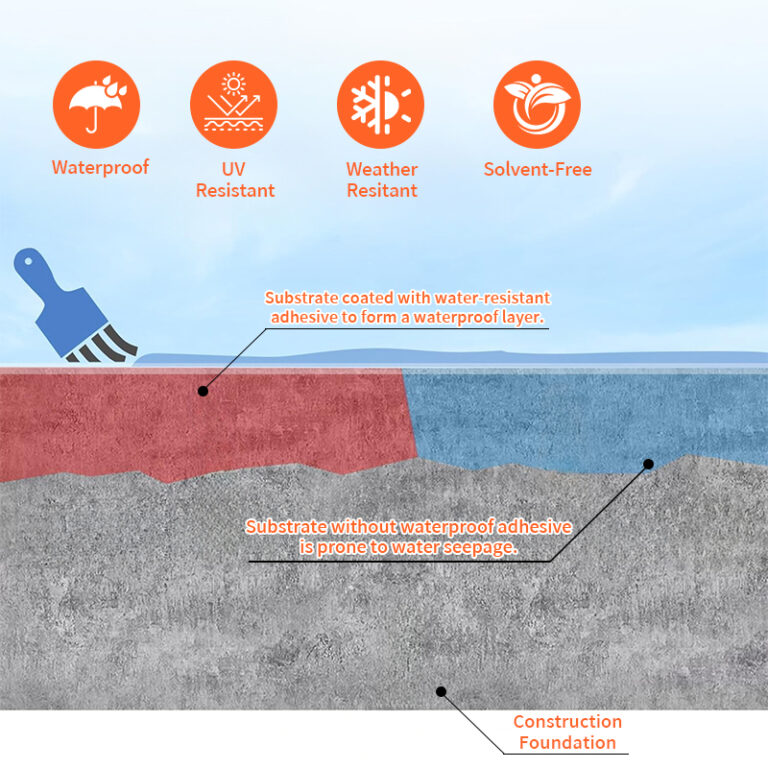
Waterproofing is not a single product category. It is a family of materials engineered for different substrates, different climates, and different performance requirements. A manufacturer’s catalog typically spans several distinct product lines.
Cementitious waterproofing products are cement-based coatings that bond directly to concrete and masonry. They are applied like paint or troweled on, and they cure to form a rigid, water-resistant layer. These are common in wet areas such as bathrooms, retaining walls, and water tanks because they can be applied to damp substrates and are compatible with concrete.
Liquid membrane coatings include polyurethane, acrylic, and polymer-modified asphalt systems. These are applied as liquids and cure to form seamless, flexible membranes. Polyurethane coatings are prized for their elasticity and UV resistance, making them suitable for exposed roofs and balconies. Acrylic coatings are more economical and are used in less demanding applications. Polymer-modified asphalt offers good adhesion and is often used in below-grade applications.
Cementitious and liquid membranes dominate the field-applied segment. But manufacturers also produce sheet membranes, including bituminous sheets, TPO, PVC, and EPDM. These are factory-manufactured rolls that are adhered or mechanically fastened to the substrate. Sheet membranes offer consistent thickness and are often preferred for large, flat areas such as commercial roofs and foundation walls.
Crystalline waterproofing is a specialized category. These products penetrate concrete and react with moisture and free lime to form insoluble crystals that block capillaries and cracks. They are used in below-grade structures, tunnels, and water containment where long-term performance and self-sealing properties are valued.
The Chemistry Behind Performance
The performance of a waterproof coating depends on its chemistry. Polyurethane coatings are formed by reacting isocyanates with polyols, creating a polymer network that is flexible, tough, and resistant to water and chemicals. The ratio of components and the additives used determine the coating’s elongation, tensile strength, and UV stability.
Acrylic coatings are water-based emulsions of acrylic polymers. They are easy to apply, low in odor, and environmentally friendly, but they are less elastic and less durable than polyurethane. They are suitable for above-grade applications where UV exposure is moderate and movement is limited.
Cementitious coatings rely on Portland cement chemistry modified with polymers. The polymer improves adhesion, flexibility, and water resistance. These coatings are rigid, so they are not suitable for substrates that move significantly, but they are excellent for concrete and masonry.
Crystalline waterproofing uses proprietary chemical blends that react with moisture and calcium hydroxide in concrete to form crystals that grow into cracks and pores. The reaction is catalyzed by water, so the material remains dormant until moisture is present and reactivates if new cracks form.
What Separates a Good Manufacturer From a Poor One
The waterproofing industry has no shortage of products. What separates a manufacturer that supports its customers from one that simply sells drums of liquid is the depth of its technical capability and the rigor of its testing.
A good manufacturer tests its products under conditions that simulate real-world exposure. This includes accelerated weathering, immersion, freeze-thaw cycling, crack bridging, and adhesion testing. The results are documented and made available to specifiers.
A good manufacturer also understands substrates. Concrete, masonry, metal, wood, and existing membranes all require different surface preparation and primers. A manufacturer that provides clear guidance on substrate preparation and primer selection reduces the risk of adhesion failure, which is one of the most common causes of waterproofing failure.
A good manufacturer provides warranty support. Waterproofing failures are expensive to repair, and a meaningful warranty backed by technical support gives specifiers and building owners confidence that the manufacturer stands behind its product.
Finally, a good manufacturer invests in education. Waterproofing is only as good as its installation. Manufacturers that offer training, certification, and on-site support for applicators improve the odds that their products will perform as intended.
How Specifiers Choose
Specifiers, including architects, engineers, and contractors, evaluate waterproof coating manufacturer on several criteria. Performance data is the starting point. Products must meet the requirements of the application, whether that is a roof, a foundation, a bathroom, or a tunnel.
Compatibility with the substrate and with adjacent materials is critical. A coating that does not adhere to the substrate or that reacts with an existing membrane will fail regardless of its intrinsic properties.
Application requirements matter. Some products require specialized equipment or skilled applicators. Others are designed for ease of use by general contractors. The specifier must consider who will install the product and whether they have the necessary skills.